

Biothane Long Line: Material, Lengths and How to Train Right
Looking for a Biothane long line for your dog – but not sure: which length? 5 m, 10 m or 15 m? Which width? And how do you actually train with one? Here's the honest guide: material, concrete length recommendations by size and training stage, the most important care tips, and 7 things that often go wrong in long-line training. Plus: why Biothane is the most stress-free material for long lines ♡
What is a long line?
Short answer: A long line is an extra-long dog leash that lets your dog roam in a defined radius without you having to take him off entirely. The dog drags the line behind him (the German term "Schleppleine" literally means "drag leash"), and you keep the safety of being able to grab or stop him at any moment.
A long line is not the same as a regular leash. The differences:
- Standard leash: 1–2 m, for guided walks at your side
- Long line: 5–15 m, for controlled off-leash training
- Retractable leash: not the same — always slightly tight, can actually interfere with recall training
What do you need a long line for?
- Recall training — your dog gets freedom of movement, you keep the safety
- Young dogs / puppies who don't yet come reliably
- High-prey-drive dogs where off-leash would be risky
- Tracking and search games in meadows and woods
- First free exploration after moving to a new home
Why Biothane for the long line?
The material matters more in long-line training than most people think. A long line constantly drags through grass, puddles, mud, dog poop (you know 🙄). Classic materials like nylon soak through, start to smell, get knots in the wet fibers. Leather isn't even an option — wet, the line would be ruined in one training session.
Biothane is exactly the right material for this kind of use:
- Waterproof – doesn't absorb moisture, dries in minutes
- Dirt-repellent – mud, sand, dog poop: wipe once, done
- Odor-neutral – still doesn't smell like wet dog after 50 walks
- UV-stable – summer sun, puddle ice in winter, color stays
- Tear-resistant – even when your dog smashes into the line at full speed
- Lightweight – important on 10 m, because weight adds up
Rudi-approved ✓ – One of our Biothane long lines has been in daily forest use for over two years with one of our test dogs. Looks like day one.
Which length is right?
The most important question — and there isn't one answer. The right long-line length depends on two things: your training stage (how reliably does your dog come?) and the environment (open meadow vs. woods vs. urban).
At RudisRudel you can choose any length from 1 to 10 meters — in 1-meter increments. Here's our honest recommendation per use case:
| Length | Ideal use | For whom? |
|---|---|---|
| 1–3 m | Long lead for city + first training steps | City dogs, controlled environment, puppies |
| 5 m | First long-line training, puppies, dense woods | Beginning recall training, small dogs, narrow paths |
| 7–8 m | Standard for meadows and parks | The all-rounder – if you only want one length, get this |
| 10 m | Open spaces, advanced recall, tracking and search work | Medium to large dogs, wide fields without obstacles |
Rule of thumb: Start shorter. A 10 m line in dense underbrush isn't a help, it's a knot drama. You can always go longer later — when ordering you can freely choose the length between 1 and 10 meters.
If you need flexibility across multiple lengths – check our leash length guide for all leash types.
Which width — 9, 13 or 16 mm?
For Biothane long lines, after the length comes a second question: how wide should the strap be? Rule of thumb:
- 9 mm – ideal for small to medium dogs up to about 20 kg. Light, discreet, runs cleanly through the hand. Our standard recommendation.
- 13 mm – for larger dogs (20–35 kg) or if you want extra stability. Slightly grippier, slightly heavier.
- 16 mm and more – for very large, strong dogs (35+ kg) or pro training with sudden stops. Massive, but overkill for 90% of dogs.
Important: A wider line is not automatically safer. 9 mm Biothane doesn't tear easily for a medium-sized dog. The hardware (carabiners, swivels) is the weak point — that's why at RudisRudel we only use tested brass carabiners ♡
Long-line training: 7 things you need to watch
A long line isn't a self-runner. Here are the points that often go wrong in training – from years of experience with hundreds of dogs in the pack:
- Never attach directly to the collar. A sudden stop on 5 m+ length can hurt the cervical vertebrae. Always clip into a chest harness.
- Long pants + sturdy shoes for you. A 10 m line that suddenly goes taut can rip your legs or knock you over.
- Never wrap the end around your hand. If your dog bolts, you'll get hurt. Hold the line open, drop it if you have to.
- Practice on open ground first. In dense forest the line tangles around trees in seconds. Frustrating for you, frustrating for your dog.
- Wet grass = slalom risk. On puddle meadows the line slings around. Use a shorter version (5–7 m) or pause if conditions don't fit.
- Train recall first. A long line doesn't replace recall training, it complements it. Your dog should already know what "Come!" means.
- Take breaks. 20 minutes of focused long-line training is enough. More just becomes frustrating for both of you.
Tip from the pack: Tie knots every 2 m in your long line — gives you a better grip if you need to shorten it quickly, and makes it easier for your dog to learn (he feels when you grab).
Care: keeping your Biothane long line pretty for years
Honest truth: care effort for Biothane = nearly zero.
- Daily: If it got wet — just air dry. Radiator works too, but not necessary.
- Mud: Rinse with clean water or hold under the tap. For stubborn dirt: lukewarm water, mild dish soap, soft brush.
- Dog poop: Wipe clean immediately. Biothane absorbs nothing, the smell goes completely.
- NOT in the washing machine — the carabiners can damage the drum. Hand-wash in the sink is the best way.
- What you do NOT need: leather oil, waterproofing spray, solvents, hard scrubbing.
More care details for Biothane (also for collars and shorter leashes) are in our Biothane material guide.
Biothane vs. Paracord vs. Leather as long-line material
Long lines come in other materials too. Here's the direct comparison – with the honest answer of what's better when:
| Biothane | Paracord | Leather | |
|---|---|---|---|
| Waterproof | ✓✓✓ | ✓ (dries fast, absorbs a bit) | ✗ (needs care, gets ruined) |
| Cleaning | Wipe, done | Rinse | Leather oil, care |
| Weight | Medium | Very light | Heavy (critical on 10 m) |
| Tear strength | ✓✓✓ | ✓✓✓ | ✓✓ (drops with moisture) |
| Look | Modern, sleek, colorful | Sporty-braided | Classic (but impractical) |
| Best for | All-weather, all-round | Small dogs, summer hikes, discreet look | City walks rather — unsuitable as long line |
Still unsure – we have a thorough rope leash material guide comparing rope, Biothane, and leather in general. For long lines, Biothane is usually the best choice. Paracord is the lighter alternative for smaller dogs or if you prefer the braided look.
Our Biothane long lines in the Mix & Match system
At RudisRudel you can plug your long line into your favorite color world – matching the collar, bandana, and daily walking leash. Here are our Biothane long lines from the style worlds:
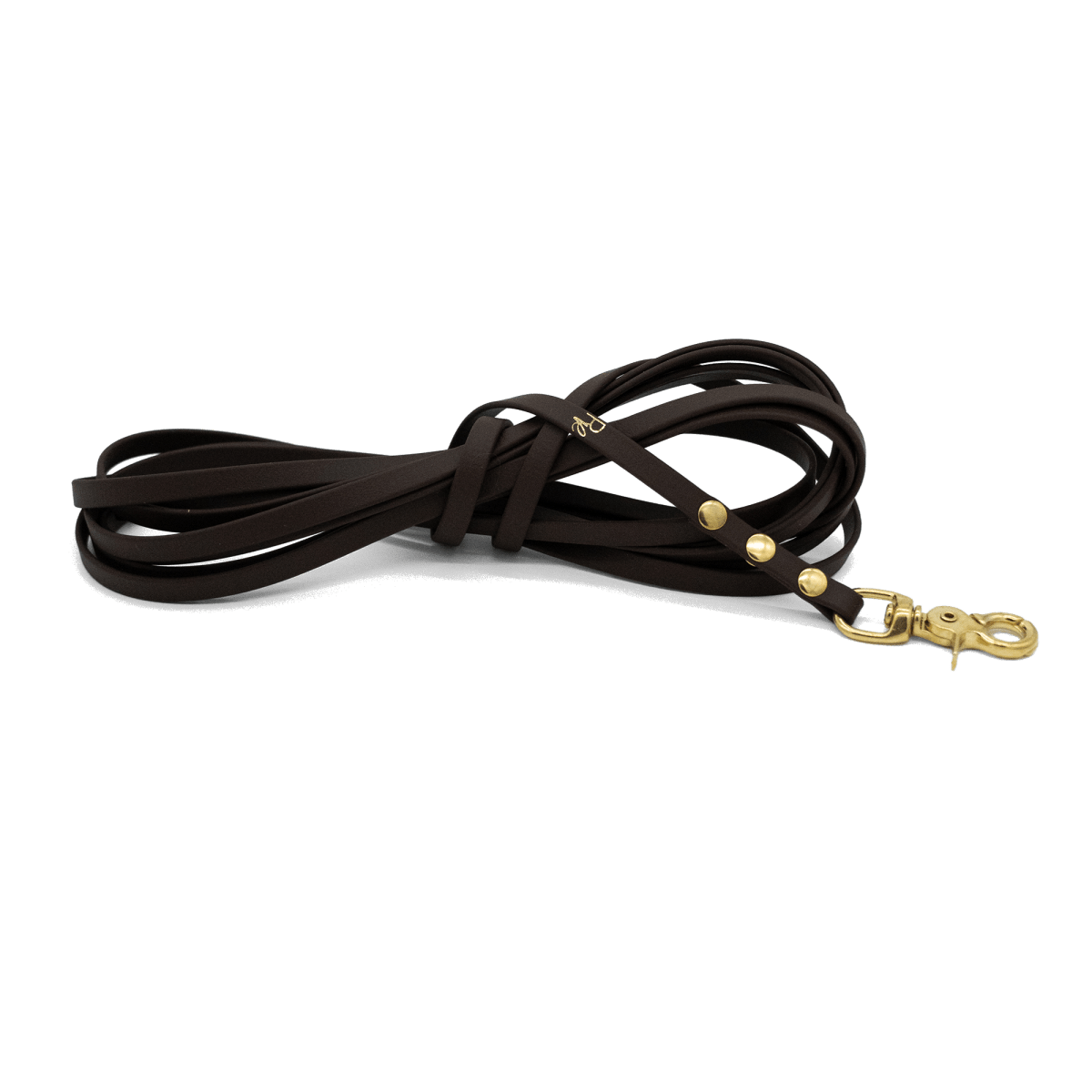
Boho Chic
Warm earth tones, brass
- Sand, sage, terracotta
- 9 mm Biothane
- 1 – 10 m freely selectable
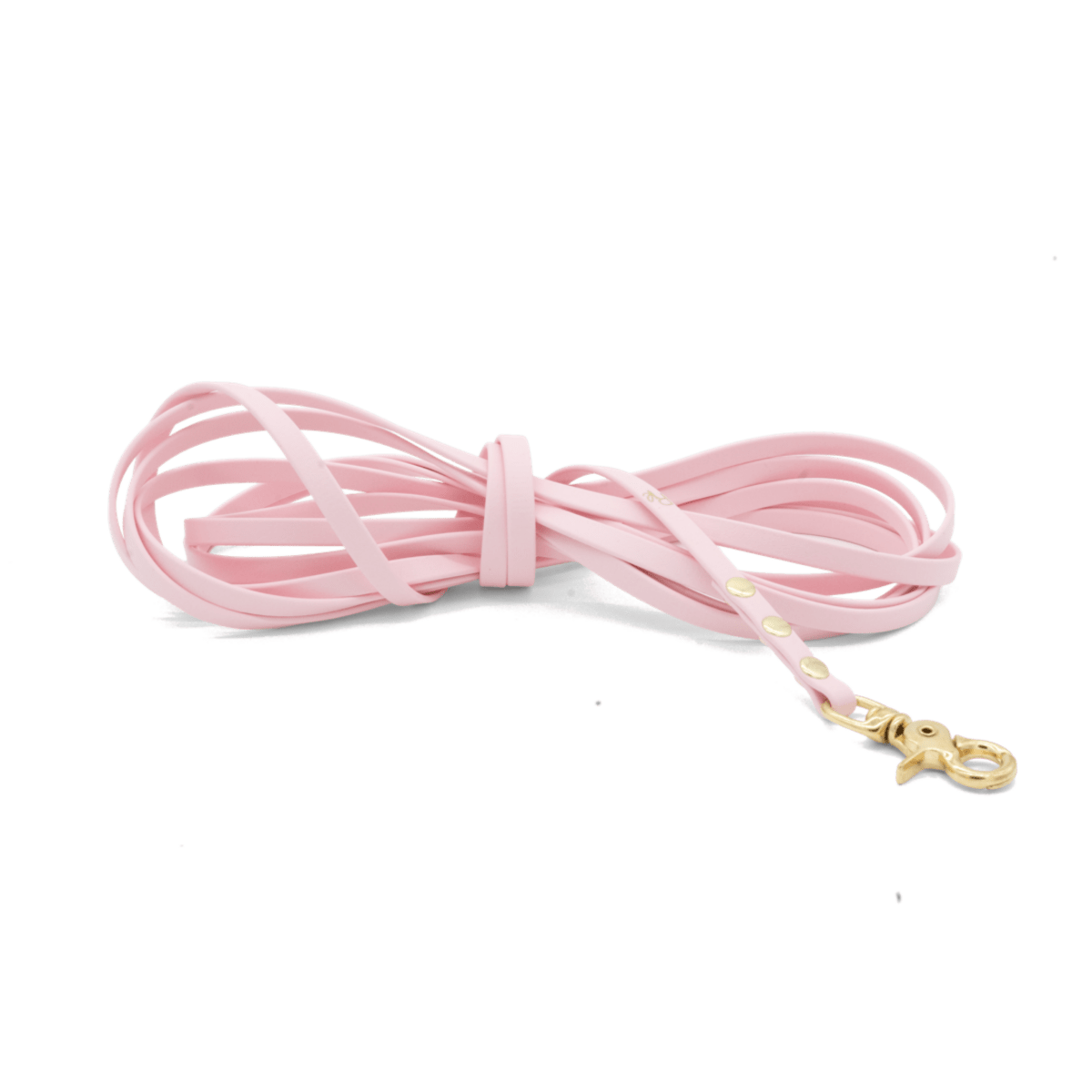
Pastel Dreams
Soft pastels, rose gold
- Pink, mint, lavender
- 9 mm Biothane
- 1 – 10 m freely selectable

Colour Clash (Paracord)
Bold colors, paracord
- Bold combinations
- Paracord version
- For small dogs
Note: For the Colour Clash world, we currently make the long line in paracord — same performance on the meadow, just with the braided look instead of the sleek Biothane finish. For pure Biothane look, Boho Chic or Pastel Dreams.
FAQ — Biothane long line
Which length is right for my puppy?
For puppies under 6 months we recommend 5 m – manageable, easy to handle and plenty for first recall practice. Once your dog grows and recall is solid, you can move up to 7 or 10 m.
Can I clip the Biothane long line directly to the collar?
We don't recommend it. A sudden stop on 5 m+ length creates major forces — that can hurt the cervical vertebrae. Always use a well-fitting chest harness that distributes the force across the chest.
Does the Biothane long line float?
The line itself doesn't (Biothane has a density above 1) — but it doesn't absorb water, so it sinks more slowly than nylon. If you drop it into water, it isn't gone, it stays where it landed.
What to do if the long line gets tangled?
First stop, ask your dog to sit. Then calmly untangle the line — never pull, that tightens knots. Tip: on narrow paths use shorter long lines (3–5 m) — dense woods + 10 m line = guaranteed frustration.
How does a long line differ from a retractable leash?
A retractable / flexi leash has a spring mechanism and is always slightly taut — your dog never gets the feeling of true freedom. A long line is loose, your dog barely feels it, it just drags behind. For recall training and free movement, a long line is significantly better.
How long does a Biothane long line last?
With normal use — 30–60 minutes daily training, occasional puddles, occasional mud — many years. We have customers whose long line from 2023 is still in daily rotation. The weakest point usually isn't the material but the carabiner. You can swap that out easily inside the Mix & Match system.
Ready for relaxed long-line training?
If you now know which length and width fit your dog after this guide – come browse our collection. Every long line is handcrafted in our small workshop by Julia, with tested brass hardware and in your favorite color world. Become part of the pack ♡
Made with ♡ by RudisRudel · Quality control by Rudi